
Вот так тоже бывает - напишешь книгу, а потом оказывается, что она - к юбилею Карлоса Кастанеды (25-го декабря - 100 лет)...
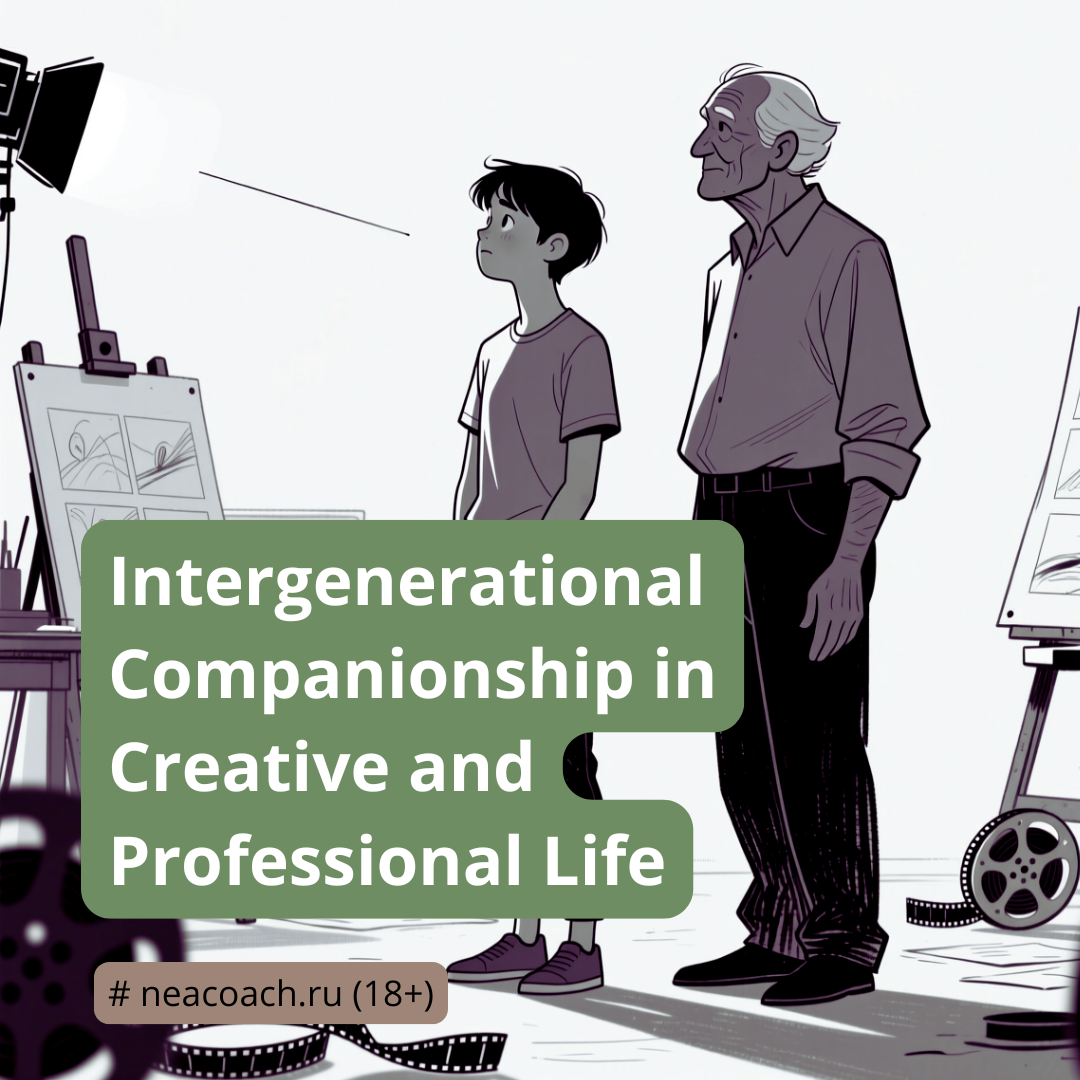
Intergenerational Companionship in Creative and Professional Life
Author: Elena Nechaeva —
psychologist, psychoanalyst
In practice since: 2007
Author’s website: neacoach.ru
Contact: nechaevacoach@mail.ru
Yekaterinburg, November 19, 2025
Dear colleagues!
This English translation is, in a sense, an experiment. I do not speak English myself. Fortunately, artificial intelligence now exists—and I turned to it for help. I am unable to verify how nuanced, precise, or clinically appropriate the translation is, but I sincerely hope for the best!
— Elena Nechaeva
Abstract
This article explores the psychoanalytic dimensions of intergenerational companionship — a form of voluntary collaboration between individuals separated by generations yet united by a shared project, creative endeavor, or professional quest.
Drawing on archetypal models, transference theory, and insights into bodily communication, it examines the unconscious mechanisms underpinning such relationships: projections of authority and futurity, the psychological “rehearsal” of maturity, and the exchange of embodied survival strategies.
Particular attention is paid to gendered patterns of interaction and to the historical and cultural conditions shaping mentorship in the Russian context.
The article emphasizes that the stability of intergenerational alliances depends on clear role boundaries and the participants’ capacity to recognize one another not as objects of projection, but as bearers of autonomous experience.
The text is addressed to specialists in psychoanalysis, pedagogy, film directing, and other creative fields where age difference becomes a resource rather than a barrier.
Introduction
When — or if — social institutions such as family, school, or profession lose their stabilizing function, individuals increasingly feel a need for personal, reliable forms of connection capable of replacing a receding sense of authority and blurred reference points.
One such form, consistently compelling to the unconscious, is intergenerational companionship — a voluntary, non-hermetic, yet meaningful alliance between people separated by generations yet united by a shared project, creative vision, or professional quest.
These relationships — whether between a mentor and student in a rehearsal space, a director and cinematographer on a film set, or a researcher and his younger colleague — rarely arise by chance.
Their foundation often lies deeper than conscious motives: in the realm of projections, archaic expectations, and unresolved inner dialogues with the figure of the “elder” or the “younger.”
Yet, unlike familial or romantic bonds, intergenerational companionship offers a unique possibility for closeness in which a crucial psychic task can be fulfilled — not so much the transmission of knowledge, but the exchange of symbolic trust.
This article explores the psychological and unconscious mechanisms underlying such alliances.
We deliberately focus on forms of interaction built around joint activity, creative collaboration, or professional exchange, consciously avoiding spheres where motivations might be ambiguous.
Our aim is not to judge, but to understand: how, through an encounter with another age, a person reclaims lost parts of their own psyche, strengthens their identity, and finds support in a world where respect for experience and faith in the future often drift apart.
Introduction When — or if — social institutions such as family, school, or profession lose their stabilizing function, individuals increasingly feel a need for personal, reliable forms of connection capable of replacing a receding sense of authority and blurred reference points.
One such form, consistently compelling to the unconscious, is intergenerational companionship — a voluntary, non-hermetic, yet meaningful alliance between people separated by generations yet united by a shared project, creative vision, or professional quest.
Such relationships — whether between a mentor and student in a rehearsal space, a director and cinematographer on a film set, or a researcher and his younger colleague — rarely arise by chance.
Their foundation often lies deeper than conscious motives: in the realm of projections, archaic expectations, and unresolved inner dialogues with the figure of the “elder” or the “younger.”
Yet, unlike familial or romantic bonds, intergenerational companionship offers a unique possibility for closeness in which a crucial psychic task can be fulfilled — not so much the transmission of knowledge, but the exchange of symbolic trust.
This article explores the psychological and unconscious mechanisms underlying such alliances.
We deliberately focus on forms of interaction built around joint activity, creative collaboration, or professional exchange, consciously avoiding spheres where motivations might be ambiguous.
Our aim is not to judge, but to understand: how, through an encounter with another age, a person reclaims lost parts of their own psyche, strengthens their identity, and finds support in a world where respect for experience and faith in the future often drift apart.
Archetypal Foundations of Intergenerational Companionship
Intergenerational alliances — especially those emerging in the spheres of art, science, or craftsmanship — rarely reduce to a mere pragmatic exchange of skills.
Their stability and emotional depth often point to deeper, archetypal roots.
For centuries, two figures have been embedded in the collective imagination of humanity, their meeting forming a stable narrative pattern: the Sage and the Young Seeker.
The Sage is not merely a bearer of knowledge but a guardian of order, a symbol of a completed path, and a sentinel at the boundary between chaos and meaning.
His role is not to instruct in the literal sense, but to open access to what already exists within the student yet remains hidden.
The Young Seeker, in turn, embodies not naïveté but the potential for transformation: he has not yet defined himself — and precisely in this lies his strength.
His journey begins with a question, not an answer.
These figures appear across diverse cultures — from Odysseus mentoring his son Telemachus, to the image of the elder in Eastern teachings who conveys the path through silence and action.
In the Russian tradition, we find the helmsman, the elder brother in folk tales, and the “master” in artisan guilds, whose recognition carried more weight than any formal diploma.
From the perspective of analytical psychology, such relationships activate structures of the collective unconscious.
The elder may be unconsciously perceived as a carrier of inner authority — what Jung termed the “Self” — especially in contexts where external reference points have become blurred.
The younger, in turn, often becomes for the elder a living symbol of the future: not merely a successor to a craft, but a vivid reminder that meaning is transmitted rather than lost.
Of particular interest is Jung’s concept of Shadow integration through encounter with “the other age.”
The elder may project onto the younger a disowned part of himself — spontaneity, boldness, bodily aliveness.
The younger, in turn, may identify with the mature figure to compensate for his own sense of immaturity or uncertainty.
In fortunate cases, such an encounter does not lead to fusion or imitation, but initiates a dialogue between inner figures — the old man and the youth who dwell within each of us. It is precisely for this reason that enduring intergenerational alliances — whether in a workshop, a laboratory, or on a film set — often possess remarkable creative fertility: they allow participants to temporarily occupy the position that, in ordinary life, remains in the shadow, and — through recognition of the other — to return to themselves more fully and integrally.
Transference and Countertransference Outside the Analytic Setting
Outside the therapeutic space, transference does not disappear — it merely changes form.
In the context of mentorship, rehearsal work, or collaborative creativity, it manifests with particular intensity: here, as in the analytic dyad, an encounter occurs between individuals of unequal maturity, experience, and symbolic weight.
However, unlike in the psychoanalyst’s office, such relationships rarely possess a reflexive framework capable of containing unconscious projections.
The younger participant in an intergenerational alliance often unconsciously “tries on” their future by encountering the figure of the elder.
This is a form of psychic rehearsal: through observation, imitation, resistance, or even rejection, they model possible scenarios of their own maturity.
Sometimes a hidden fear underlies this process: maturity appears alternately as a loss of freedom, as the burden of responsibility, or as the threat of stagnation.
The elder, in turn, may perceive the younger as a mirror of their own past — sometimes with nostalgia, sometimes with irritation, and sometimes even with envy for energy that has not yet been spent.
Thus emerges a complex dynamic of transference and countertransference:
— the younger may idealize the elder, seeing in them an embodiment of confidence, wisdom, or stability that they themselves have not yet internalized;
— the elder, in turn, may project onto the younger unfulfilled hopes, unrealized ambitions, or even fear of their own aging, attempting to “reanimate” themselves through the other.
These projections are not necessarily destructive — provided both parties maintain clarity in role boundaries.
Problems arise when the frame dissolves: the mentor begins to demand personal loyalty instead of professional growth, or the student expects emotional salvation rather than guidance.
In such cases, idealization easily turns into disillusionment, and disillusionment into devaluation: the elder is labeled “outdated,” while the younger is branded “ungrateful.”
Particularly vulnerable to such shifts are spaces marked by high emotional involvement: the rehearsal room, the film set, the art studio.
Here, physical proximity — working “shoulder to shoulder” — intense eye contact, and shared experiences of crisis or success amplify projective mechanisms.
If there is no clarity about what truly connects the individuals — a shared task or personal expectations — the alliance quickly loses its stability.
Thus, the ethics of intergenerational companionship begins not with moral injunctions, but with conscious maintenance of the frame: the elder as a bearer of function, not an object of adoration; the younger as a subject of growth, not a tool for self-validation.
It is precisely within this containment that genuine trust arises — not blind, but tested; not infantile, but collaborative.
The Body, Age, and Symbolic Exchange
Age is not merely a biographical fact — it is a bodily reality. It is read long before words are spoken: in posture, breathing rhythm, reaction speed, and the way one occupies space.
In intergenerational companionship, this bodily difference becomes not a backdrop, but an active participant in the dialogue — sometimes even more honest than speech.
The young body often radiates impulse: it is ready for movement, risk, and improvisation.
Yet it may also carry uncertainty — a tremor before a decision, tension in the shoulders under responsibility, laboured breathing at the moment of “entering the frame.”
The older body, by contrast, typically demonstrates structure: it knows how to distribute weight, restrain a gesture, remain silent.
Yet behind this composure may lie bodily fatigue, slowness, or even — a fear of a new movement, a new role, a new gaze from the audience.
It is precisely in these mismatches that symbolic exchange emerges.
A young person, watching how a mature colleague calmly maintains focus amidst the chaos of a film set, does not merely learn technique — they absorb a way of being in stress without disintegration.
The elder, observing how the younger enters the frame effortlessly, without preliminary protective rituals, may — even unconsciously — recall a lightness once lost under the weight of control.
Notably, such encounters often involve an exchange not so much of knowledge, but of bodily survival strategies.
The younger borrows from the elder a way to contain anxiety — for example, through rhythmic breathing or precise attention allocation.
The elder, in turn, borrows from the younger a readiness for open bodily contact with the unknown — without pre-emptive “armouring” in a role, without a mask.
Of particular importance in this context is the fear of being seen.
For a young person entering a professional field, this is often the first experience of their body becoming an object of evaluation — not only for skill, but for presence, for “emanation.”
The fear of making a mistake, appearing awkward, or seeming “out of place” can provoke stiffness, masking, or excessive “theatricality.”
A mature companion, if they possess bodily integration, can non-verbally convey: “You can be here — even if you’re unsure. Just be.”
This is one of the most valuable, though rarely conscious, forms of support.
Conversely, the elder may harbour an invisible fear of bodily obsolescence: “If I no longer move as I once did — am I still relevant?”.
An encounter with a younger person — especially one genuinely interested in their experience — becomes a confirmation: the body ages, but presence endures.
Thus, intergenerational companionship in embodied professions — from directing to sport — is not merely a transmission of technique.
It is an indirect yet profound dialogue between different stages of bodily and psychic life, in which each receives what they lack: the younger gains structure, the elder receives affirmation of vitality.
And this exchange occurs not in words, but in how two people stand side by side — in the frame, on stage, in life.
Intergenerational Duos in Creative Professions
Creative fields — cinema, music, theatre, and visual arts — are inherently structured as spaces of transmission.
Historically, they relied on mentorship models: master and apprentice, director and assistant, composer and copyist.
Today, amid acceleration and fragmentation of experience, such bonds have become less formalised — yet no less significant.
Moreover, in low-budget or no-budget projects, where resources are limited but responsibility is high, intergenerational companionship often becomes nearly the only stabilising factor.
Consider, for example, a film crew where an experienced cinematographer collaborates with a young director.
The former possesses knowledge of lighting, composition, and technical pitfalls; the latter brings a fresh perspective, inner rhythm, and sometimes even an intuitive sense of the frame.
Their collaboration may begin with tension: one speaks the language of technique, the other — the language of metaphor.
Yet, if mutual recognition of competencies is achieved, a rare state emerges — creative trust.
It does not require agreement on everything, but it does presuppose respect for another way of seeing.
A similar dynamic operates in music: a seasoned producer and an emerging performer may find common ground not through compromise, but through complementarity.
One offers structure; the other — impulse.
One knows how to bring a project to the audience; the other knows how to speak to them in an authentic voice.
The key here is not the suppression of one voice by another, but the creation of a third sound — impossible without both.
In the teaching of creative disciplines, intergenerational duos are especially valuable.
A young educator may easily connect with teenagers but may lack methodological grounding or patience in crisis moments.
A mature mentor, in turn, possesses a stable system but may sometimes lose “tactility” — the ability to sense the pulse of a new generation.
Their collaboration enables the creation of a hybrid pedagogy, one that holds both respect for tradition and openness to change.
Yet such alliances also carry risks:
— Fear of replacement: the elder may worry the younger will “leapfrog” them, stripping them of status.
— Hidden competition: the younger, having gained experience, may hastily reject the mentor to assert independence.
— Idealisation as a trap: if the younger sees the elder as the “perfect master,” critical thinking is lost; if the elder sees the younger as the “ideal successor,” they risk projecting unrealistic expectations.
This is why clarity of function is especially crucial in creative professions: who decides the frame composition, who is responsible for the script, who leads the rehearsal.
When roles are clear, the space for unconscious projections narrows, and room for genuine collaboration expands.
And then the intergenerational duo ceases to be a story about age — and becomes a story about a shared task that matters more than either participant, yet matters deeply to both.
The Gendered Dimension: Male and Female Patterns of Companionship
Although the unconscious mechanisms of transference, idealisation, and the search for support are universal, their manifestations in intergenerational companionship can differ significantly depending on the participants’ gender.
These differences are not rooted in biology, but in culturally embedded models of socialisation that shape distinct expectations regarding closeness, authority, and mutual assistance.
Male intergenerational duos have traditionally been structured around hierarchy and ritual.
Personal rapport matters less here than the transmission of function — the “baton,” the tool, the position, the reputation.
The younger expects not so much empathy as recognition — and receives it not through embraces, but through entrustment with a task: “Shoot this frame yourself,” “Take the crew in hand.”
The elder, in turn, affirms their significance not through care, but through a demonstration of the ability to maintain distance while remaining precise.
Such relationships often contain a hidden element of competition, yet healthy rivalry here is not a threat, but a way of testing the younger’s readiness to “take the baton.”
The key risk in male duos is the suppression of emotions.
When boundaries are violated, conflict tends to be expressed through withdrawal or sarcasm rather than dialogue.
Therefore, the stability of such alliances depends on the presence of an external task that serves as the “third” — that for which both are willing to set pride aside.
Female intergenerational duos, by contrast, more often develop around empathy, mirroring, and the exchange of inner experience.
What matters here is not so much the transfer of a position, but the transmission of the capacity to be heard.
The younger seeks not only advice, but recognition of her complexity; the elder seeks not only a student, but a continuator of an inner dialogue.
Such bonds can be deeply supportive, yet they carry their own risks: a tendency toward emotional fusion, difficulty establishing boundaries, and rapid disillusionment at the slightest breach of expectations.
Interestingly, female duos often include an element of “passing on a secret” — not in the literal sense, but as the sharing of personal survival strategies: how to cope with doubt, how to retain one’s voice in a group, how not to disappear within a role.
This constitutes a form of intangible heritage, no less valuable than a professional skill.
In both cases, gendered patterns can either support or hinder the relationship.
Male restraint preserves distance but can block feedback.
Female emotional openness accelerates connection but may sometimes impede objective assessment.
Thus, the most resilient intergenerational alliances — whether male or female — are those in which participants recognise these patterns and consciously work with them, rather than allowing them to govern the relationship from the shadows.
Cultural and Historical Frameworks
Forms of intergenerational collaboration never exist in a vacuum — they are shaped by specific cultural traditions, institutional practices, and historical ruptures.
In the Russian context, such relationships possess particular depth, as throughout the twentieth century the transmission of knowledge and experience was closely embedded in professional, artisanal, and educational structures, where the figure of the elder played not a peripheral but a central role.
During the Soviet period, mentorship was not merely a personal initiative but a socially institutionalised practice — from production brigades to art schools. The “senior comrade” or “workshop master” bore responsibility not only for the quality of output but also for the professional development of their protégé.
This model rested on the idea of collective continuity: one individual’s success was seen as a contribution of the entire generation.
Although formally oriented toward production goals, on an unconscious level this system fulfilled an important psychic function — it provided a sense of belonging to a stable order in which everyone knew their place and their path.
The rupture of the 1990s entailed not only economic but also symbolic losses.
Traditional figures of authority — teachers, masters, mentors — were devalued within the new logic of individual success.
Many young people of that era were forced to build professional paths without the support of predecessors’ experience, which fostered both valuable independence and a hidden anxiety: “Am I on the right track?”.
The absence of stable models for transmitting experience led entire generations to reinvent their craft from scratch, often losing in the process essential yet intangible elements — professional ethics, embodied habits, inner discipline.
Today, we observe a kind of return to the idea of companionship, but in new forms: not as an administrative obligation, but as a conscious choice.
This is especially evident in creative fields, where young professionals increasingly seek not just courses or workshops, but the personal presence of someone who has already walked the path.
Meanwhile, the older generation — having lived through an era of eroded trust — is becoming ever more acutely aware: experience that is not passed on is lost.
Importantly, contemporary intergenerational alliances are no longer about restoring old hierarchies.
They are about achieving a new equilibrium: where the elder does not dictate but offers; where the younger does not submit but chooses.
This approach allows us to avoid both paternalism and cultural amnesia. It preserves respect for the past — not at the expense of denying the present.
It is precisely in this that one of the key potentials of intergenerational companionship lies today: not to restore the past, but to bridge epochs through trust in a shared task.
And then age ceases to be a barrier — and becomes a resource.
Author’s note. My personal experience: it was in the early 1990s that I studied film directing at a higher educational institution. Against the backdrop of broad socio-political and economic transformations, I observed no deviations from established professional norms in student–teacher relationships. What unfolded between the younger and older generations within the educational setting fit the classic “Fathers and Children” pattern — marked by tension, yet sustained by respect for the craft.
About the Author
Elena Nechaeva was born, lives, and works in Yekaterinburg. She is the author of books on psychology and psychoanalysis, as well as paintings in the genre of Ural underground art and music videos. She has been practicing as a psychologist and psychoanalyst since 2007, offering in-person sessions in Yekaterinburg and online consultations.
Author’s website: neacoach.ru
Contact: nechaevacoach@mail.ru